What is an urban heat island? Why cities are warmer than the countryside
Why does the air cool down on a summer evening as you leave the city centre? We explain the urban heat island through the energy budget: albedo, materials that store heat, narrow streets, shade and evaporation. At the end there is a surface temperature experiment to try at home.
In this article · 8 sections
The theme of COP31’s 12 November is Resilient Cities and Built Environment (COP31 thematic days). This article explains one of the physical effects that shapes a city’s climate the most: the urban heat island.
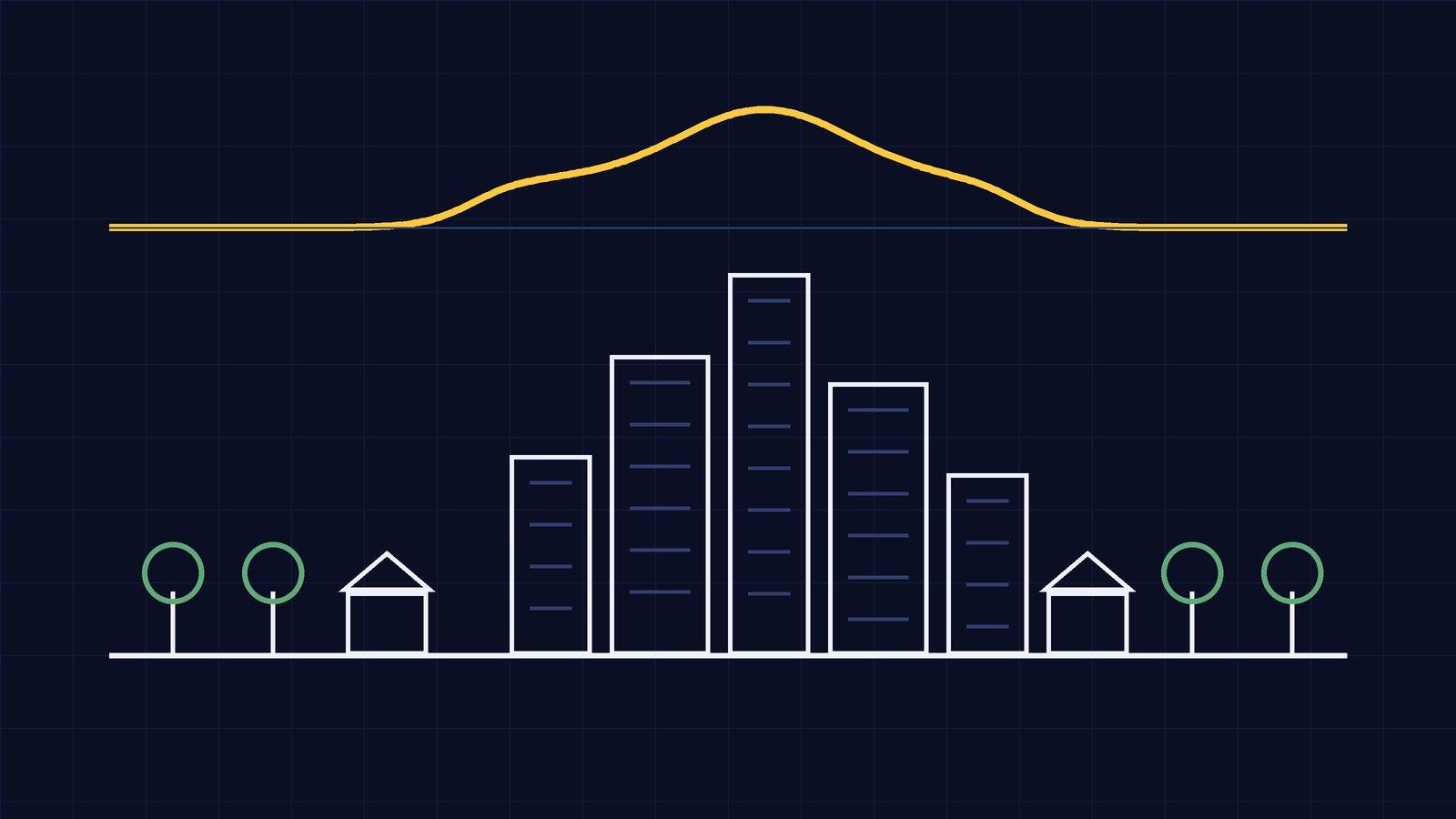
Imagine driving out of a city centre towards the countryside on a hot summer evening. When you open the car window, you feel the air become noticeably cooler. This is not just an impression; thermometers show the same thing. Cities are usually warmer than the rural areas around them. This is called the urban heat island. When temperatures are coloured on a map, the city looks like a warm island in the middle of a cool sea.
Two different heat islands
Scientists look at two separate measurements:
- Surface heat island: the temperature of surfaces such as roofs, roads and pavements. It is usually measured with infrared sensors on satellites. The US Environmental Protection Agency (EPA) reports that on a hot, sunny summer day, dry, exposed roof and pavement surfaces can be 27–50 °C hotter than the air. The surface difference is largest during the day: according to values compiled by the EPA, the difference between city and countryside is about 10–15 °C by day and 5–10 °C at night.
- Air (atmospheric) heat island: the temperature of the air people breathe, measured with thermometers. This difference is small during the day, sometimes absent, and strongest at night and before dawn. According to the same EPA compilation, the night-time difference can reach 7–12 °C.
A review of studies in the United States found that, on average, daytime air temperatures in cities are about 0.6–3.9 °C higher than in surrounding areas, and night-time temperatures about 1.1–2.8 °C higher. The difference is greater in humid regions and in large, densely built cities. These numbers change from city to city and season to season, but the direction is always the same.
A surface’s energy budget
To understand the heat island, let’s look at a single square metre of surface. Part of the incoming sunlight is reflected; the rest is absorbed and heats the surface.
The fraction of sunlight a surface reflects is called its albedo. Albedo is a number between 0 and 1: 0 describes a pitch-black surface that reflects nothing, 1 a surface that reflects all the light. The absorbed fraction is .
The heat island group at Lawrence Berkeley National Laboratory (LBNL) gives these values:
| Surface | Solar reflectance (albedo) |
|---|---|
| New asphalt | about 0.05 |
| Aged asphalt | 0.10–0.20 |
| New concrete | 0.30–0.50 |
| Aged concrete | 0.20–0.35 |
Asphalt gets lighter as it ages, because the black binder oxidises and light-coloured stone particles show through. Concrete, on the other hand, gets darker with tyre and grease stains.
Worked example: suppose 800 W of sunlight falls on each square metre of a surface (a round number chosen to make the calculation easy). New asphalt absorbs of this light:
A new concrete surface with an albedo of 0.40 absorbs W/m². Under the same light, every square metre of asphalt receives 280 J more energy every second. Most of this difference turns into heat.
For comparison: according to NASA’s data, Earth as a whole reflects about 29% of the incoming sunlight (a Bond albedo of 0.294). Clouds, ice sheets and pale deserts raise this fraction; dark oceans and forests lower it.
Reflection is not only about the colour we see. According to the EPA, about 5% of the solar energy reaching Earth’s surface is ultraviolet, 43% is visible light and the rest is infrared. That is why some “cool” paints reflect infrared well even though they look dark to the eye.
Five things that warm a city
The EPA lists the causes of heat islands as follows:
- Few plants, little water. Trees, plants and bodies of water cool the air by providing shade, by evaporating water from leaves and by evaporating surface water. In cities, they are replaced by dry, hard surfaces.
- Properties of materials. Dark surfaces absorb more solar energy. Materials such as stone, concrete and steel are good at storing heat; they slowly release the heat collected during the day after sunset. This is the main reason the air heat island grows stronger at night.
- The geometry of the city. Narrow streets lined by tall buildings are called urban canyons. During the day buildings can provide shade, but light that reaches the street is reflected back and forth between walls and absorbed. At night the infrared radiation given off by surfaces cannot escape to the sky; it hits the opposite wall instead. The cooling effect of wind is also reduced.
- Heat from human activity. Vehicles, air conditioners, buildings and industry release heat into their surroundings.
- Weather and geography. Heat islands are more noticeable in calm, clear weather, when plenty of solar energy reaches surfaces and the wind does not carry heat away. Strong winds and clouds weaken them.
Shade and evaporation: nature’s air conditioners
A tree cools its surroundings in two ways.
Shade. According to the EPA’s compendium, in summer usually only 10–30% of the solar energy falling on a tree reaches the area beneath it; the rest is absorbed by leaves, used in photosynthesis or reflected. In a measurement study reported in the same compendium, tree shade lowered the maximum surface temperatures of the walls and roofs of two buildings by 11–25 °C.
Evaporation. Plants release water taken up by their roots as vapour from their leaves. Turning water into vapour takes a large amount of energy, and that energy is taken from the surroundings. It is the same physics that makes sweating cool us down (Why does evaporation cool things down?). According to measurements reported by the EPA, peak air temperatures in tree groves can be about 5 °C cooler than over open land, older neighbourhoods with mature trees 2–3 °C cooler than new ones without trees, and grass sports fields 1–2 °C cooler than the areas around them.
Cooling surfaces down
The methods used to reduce heat islands change the terms of the energy budget:
- Cool roofs: coverings with high solar reflectance and high thermal emittance. According to the EPA, in homes without air conditioning, cool roofs can lower the maximum indoor temperature by 1.2–3.3 °C.
- Cool pavements: road and pavement materials that reflect more light or let water evaporate. In a pilot study in Arizona reported by the EPA, conventional asphalt reached about 67 °C at midday, while cool pavements stayed 6–9 °C cooler.
- Trees and green space: shade and evaporation.
Each method has its own conditions: a reflective surface can also reflect light onto nearby walls or pedestrians; trees need water. That is why city planners weigh these methods together according to the local climate.
Try it at home: two surfaces in the sun
You will need: a black and a white piece of card (or paper) of the same size, two kitchen thermometers or a single infrared thermometer, and a sunny windowsill or balcony.
- Place the two cards side by side, facing the Sun at the same angle.
- Put the thermometers under the cards in the same way (or measure the surfaces with an infrared thermometer).
- Record the starting temperatures, then a reading every 5 minutes for 30 minutes.
- Then move the cards into the shade and follow the cooling in the same way.
Predict first: which one warms up faster? Which one cools down faster in the shade? Plot your results on a time-temperature graph. The black card warming more is the effect of low albedo. If you repeat the experiment with a damp piece of cloth, you can see the effect of evaporation too.
Safety note: never look directly at the Sun, and do not touch hot surfaces with bare hands for long.
Common mix-ups
“A heat island only happens during the day.” The surface difference is large during the day, but the air heat island is most noticeable at night. Heat stored during the day is released in the evening and at night.
“A white surface destroys heat.” Energy is not destroyed. A light-coloured surface reflects a larger share of the incoming light; part of that reflected light passes back through the atmosphere into space, and part hits other surfaces.
“The urban heat island and global warming are the same thing.” The urban heat island is a local effect. The teams that produce global temperature datasets remove this local effect by comparing city stations with their rural neighbours; NASA’s GISTEMP dataset, for example, uses night-time lights seen from satellites to do this.
“Air in the shade and a surface in the sun are at the same temperature.” A thermometer in the shade measures the air temperature. A surface in the sun can be tens of degrees hotter than the air; you can feel the difference walking barefoot from asphalt onto grass.
Summary
- An urban heat island is when a city is warmer than the rural areas around it.
- The surface heat island is strongest by day; the air heat island is strongest at night.
- Albedo is the fraction of light a surface reflects; the absorbed fraction is . New asphalt has an albedo of about 0.05.
- Dark materials that store heat, narrow streets, few plants and heat from human activity warm a city.
- Shade and evaporation are the ways trees cool their surroundings.
- Cool roofs and pavements increase the reflection term in the energy budget.
You can find the difference between heat and temperature in our lesson Heat and temperature and in the article The difference between heat and temperature. In the Lab, try Same heat, different temperature to see how much the same energy warms different materials, and Seasons to see how the angle of sunlight changes the energy falling on a surface.
Frequently asked
4 questionsWhat is an urban heat island?
An urban heat island is when a city is warmer than the rural areas around it. Dark surfaces that store heat, little plant cover, narrow streets and heat from sources such as vehicles and air conditioners create the difference.
Why is the urban heat island stronger at night?
Concrete, stone and asphalt slowly release the heat they collected during the day after sunset. In narrow streets, the infrared radiation given off by surfaces cannot escape to the sky. So the city-countryside difference in air temperature is largest at night and before dawn.
What is albedo?
Albedo is the fraction of incoming sunlight that a surface reflects, a number between 0 and 1. New asphalt has an albedo of about 0.05 and new concrete between 0.30 and 0.50. The absorbed fraction is 1 minus the albedo.
How do trees cool a city?
In two ways: they cast shade, reducing the solar energy that reaches the surface below, and they evaporate water from their leaves, taking heat from their surroundings. In summer usually only 10–30% of the solar energy falling on a tree reaches the area beneath it.
Sources
9 sources- 1.COP31 Türkiye: Thematic days announced (opens in a new tab)
- 2.US EPA: Learn About Heat Islands (opens in a new tab)
- 3.US EPA: Reducing Urban Heat Islands, Compendium of Strategies; Urban Heat Island Basics (opens in a new tab)
- 4.US EPA: Reducing Urban Heat Islands, Compendium of Strategies; Trees and Vegetation (opens in a new tab)
- 5.US EPA: Using Cool Roofs to Reduce Heat Islands (opens in a new tab)
- 6.US EPA: Using Cool Pavements to Reduce Heat Islands (opens in a new tab)
- 7.Lawrence Berkeley National Laboratory, Heat Island Group: Cool Pavements (opens in a new tab)
- 8.NASA NSSDCA: Earth Fact Sheet (opens in a new tab)
- 9.Hansen et al. (2010). Global surface temperature change. Reviews of Geophysics 48, RG4004 (opens in a new tab)
- #urban heat island
- #albedo
- #surface temperature
- #shade
- #evaporation
- #COP31